
















From intake to invoice — automated.
Solo practices and boutique firms lose 12–18 hours per week on client intake, billing, and document admin. ARIA maps every manual touchpoint and delivers a prioritised AI roadmap with exact cost and ROI figures.


"I've audited dozens of small law firms. The pattern is always the same — attorneys doing $300/hr work are spending half their day on $15/hr tasks. That's the gap ARIA is built to close."
The four places law firms lose the most money to manual work.
Non-billable admin is eating your hours
Solo and boutique firms typically lose 12–18 hours per week to client intake forms, document requests, billing follow-ups, and scheduling. At $300/hr, that's $3,600–$5,400 in unbilled time every single week.
Document chaos slows every matter
Chasing signatures, organising discovery documents, and managing version control across email threads is a constant drain. Firms without automated document workflows spend 40% more time on matter prep.
Invoices go out late — and come back later
Manual billing means invoices are often delayed by days or weeks. Without automated reminders, overdue receivables pile up. The average small firm carries 34% more overdue invoices than firms using automated billing.
Client intake leaks leads
Prospective clients who don't hear back within 5 minutes are 10x less likely to convert. Manual intake processes — phone tag, email back-and-forth, paper forms — cost firms an estimated 20–30% of their inbound leads.

The average attorney spends 40% of their day on non-billable tasks. ARIA identifies exactly which ones can be automated.

"Legal tech has matured faster than most attorneys realise. The tools that existed five years ago required IT teams and six-figure implementations. The ones I evaluate today are SaaS — $50–$200/month, no IT required, and they integrate with Clio out of the box."
Six areas where AI delivers measurable ROI for law firms.
ARIA's report identifies which of these apply to your specific practice, ranks them by ROI, and gives you exact implementation costs and timelines.
Automated intake & conflict check
AI-powered intake forms collect client information, run conflict checks against your matter database, and schedule consultations automatically — 24/7, without staff involvement.

"Intake is where most firms lose prospects and don't even know it. I track every drop-off point in your intake funnel and show you exactly where leads are going cold."
Top Tools
Contract & document generation
Template-driven document automation generates engagement letters, NDAs, and standard contracts in seconds. AI reviews drafts for missing clauses and flags inconsistencies before you send.

"Document prep is the single biggest time sink I find in small firm audits. Template automation pays for itself in the first month — usually in the first week."
Top Tools
Automated billing & payment reminders
Time entries captured automatically from calendar and email. Invoices generated and sent on schedule. AI-driven payment reminders reduce overdue receivables by 34% without a single manual follow-up.

"I calculate exactly how much is sitting in overdue receivables and what automated reminders would recover. For most firms I audit, it's between $12K and $20K per year."
Top Tools
AI-assisted legal research
Large language models trained on case law and statutes surface relevant precedents in minutes instead of hours. Associates spend less time on preliminary research and more time on analysis.
"AI legal research tools have matured significantly. I evaluate which ones are actually trained on current case law for your practice area — not all of them are."
Top Tools
Client portal & status automation
Automated status updates keep clients informed without phone calls. A client portal gives 24/7 access to documents, invoices, and matter status — reducing inbound calls by 45%.
"Client anxiety drives most of the inbound calls small firms receive. A portal that shows matter status in real time eliminates 80% of those calls without any additional staff."
Top Tools
Review generation & referral automation
Automated post-matter review requests sent at the right moment increase Google review volume by 3x. Referral tracking identifies your best referral sources so you can nurture them intentionally.

"Law firms live and die on referrals, but most have no system to track where clients come from. I map your referral sources and show you which relationships are worth investing in."
Top Tools
"Clio is the benchmark I use when evaluating any law firm's tech stack. If you're not on it, I want to know why. If you are on it, I want to know how much of it you're actually using — most firms I audit are at 30–40%."
The operating system for modern law firms.
Clio is the most widely adopted practice management platform for small and mid-size firms. It combines matter management, time tracking, billing, client intake (Clio Grow), and a client portal (Clio Connect) into a single integrated stack. ARIA evaluates whether your current Clio configuration is optimised — most firms use less than 40% of its capabilities.
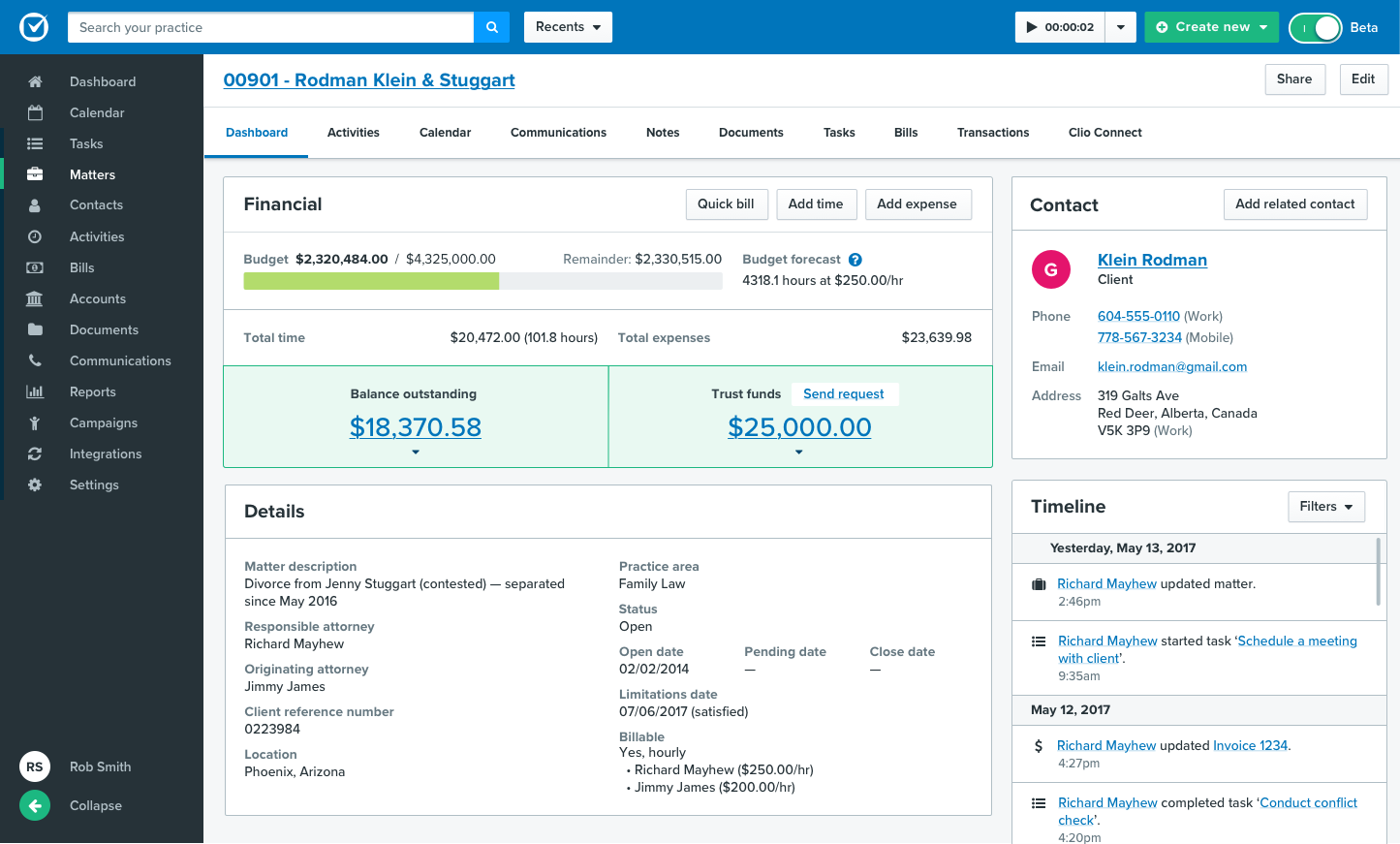
Clio dashboard — one of 6 tools ARIA evaluates for your practice
"Client experience is the most underrated growth lever in legal. A firm that responds in 5 minutes and sends automated status updates will win referrals over a better lawyer who makes clients wait. I measure where your client experience breaks down."
What a client-first law firm looks like in 2025.
The firms growing fastest aren't necessarily the best lawyers — they're the most responsive. AI-powered intake, automated status updates, and a client portal that works at midnight give small firms the responsiveness of a 50-person operation without the overhead. ARIA measures your current client touchpoints against the benchmark and shows you exactly where the experience breaks down.
The gap between client expectation and firm responsiveness is where most small firms lose referrals.
"Every firm I audit is leaving money on the table in billing. Not because they're doing anything wrong — because manual time tracking has a structural gap. I calculate the exact dollar amount and show you how to close it."
The billing gap most firms don't know they have.
Manual time tracking misses an average of 2.5 hours of billable time per attorney per week. At $300/hr, that's $39,000 per attorney per year in unbilled work — work you did, but never charged for. Automated time capture from calendar, email, and phone logs recovers that revenue without changing how attorneys work.
"These benchmarks come from aggregated data across hundreds of small firm audits. Your report will show where your practice sits on each metric — and what closing the gap is worth in dollars."
How AI-enabled law firms compare to the industry average.
| Metric | Industry Average | With ARIA Recommendations | Improvement |
|---|---|---|---|
| Non-billable hours per week | 14 hrs | 6 hrs | 57% |
| Lead-to-consultation conversion | 31% | 48% | +55% |
| Invoice collection time | 38 days | 22 days | 42% |
| Document prep time per matter | 4.2 hrs | 2.5 hrs | 40% |
| Client satisfaction score (NPS) | 42 | 67 | +60% |
| Billable time captured per attorney | 5.8 hrs | 7.9 hrs | +36% |
"I evaluate eight tools for every law firm audit. The question isn't just which tool is best — it's which tool is right for your practice size, budget, and the specific workflows you need to fix first."
The tools ARIA evaluates for your practice.
ARIA doesn't recommend tools generically — it matches tools to your specific workflow gaps, team size, and budget. Your report includes a ranked shortlist with pricing and integration notes.
Clio Manage
$49–$129/user/mo
Best overall for small firms
Clio Grow
$49/user/mo
Best intake automation
Lawmatics
$199–$399/mo
Best for lead nurturing
MyCase
$39–$99/user/mo
Best client portal
PracticePanther
$49/user/mo
Best for solo attorneys
Birdeye
$299–$499/mo
Best review automation
TimeSolv
$27–$35/user/mo
Best standalone billing
Harvey
Enterprise pricing
Best AI legal assistant
See exactly what ARIA finds in your practice.
The benchmarks above are industry averages. Your ARIA report is built from your actual intake answers, your specific tools, and your market — giving you a personalised roadmap, not a generic checklist.